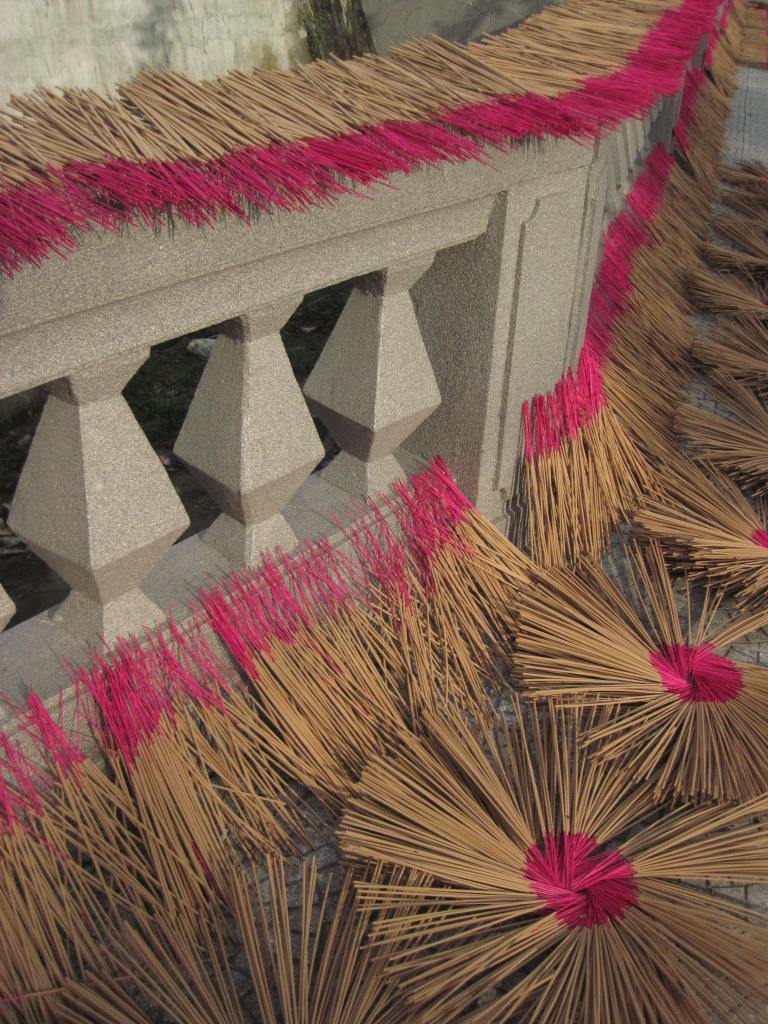
You experience a city in a unique way when you wander the streets in its early morning hours, before the stores open their doors and before the streets begin to bustle with traffic. On our first few days in Hanoi, adjusting to the 12-hour time difference, we would leave our hostel at first light. Having already been awake for several hours, we searched for that first shop ready to pour us a dainty porcelain cup of caffeinated bliss – a dark brew of Vietnamese coffee beans, syrupy thick with a generous amount of sweetened condensed milk. We watched storekeepers slide up their doors to open their shops to the street. Several took a moment to pause in the morning light, holding burning sticks of incense and bowing their heads to the dawn. Would my ordinary days be different if I welcomed them with an offering of gratitude twisting up towards heaven like a ribbon of smoke?
The earliest bus leaving Reykjavík brought me to the trailhead in Skogar at noon. To make it all the way to Landmannalaugar in four days, I couldn’t afford to wait until the following day to start north on the Fimmvörðuháls Trek. Sleeping accommodations between there and Pórsmörk were limited and had to be reserved far in advance, so I was committed to the entire 23.4 km that afternoon. Before I started, I asked another tourist to take a photo of me in front of Skogasfoss, an enormous waterfall. That day’s hike felt like an entire journey in itself, and not just because of the length. It seemed unfathomable to have traversed such a breadth of landscapes over that distance. After the short, steep ascent to the top of Skogarfoss, the trail followed the Skogar River upstream where it tumbled down a series of smaller, still photo-worthy, drops. Across the grassy highlands, two glaciers in the distance covered the tops of mountains. I stopped several times to take photos as I hiked nearer. Finally, the trail crossed a tongue of one of the glaciers. I carefully placed my feet on the slippery surface. I snapped several photos of where the ice formed peaks like meringue, darkened with ash.
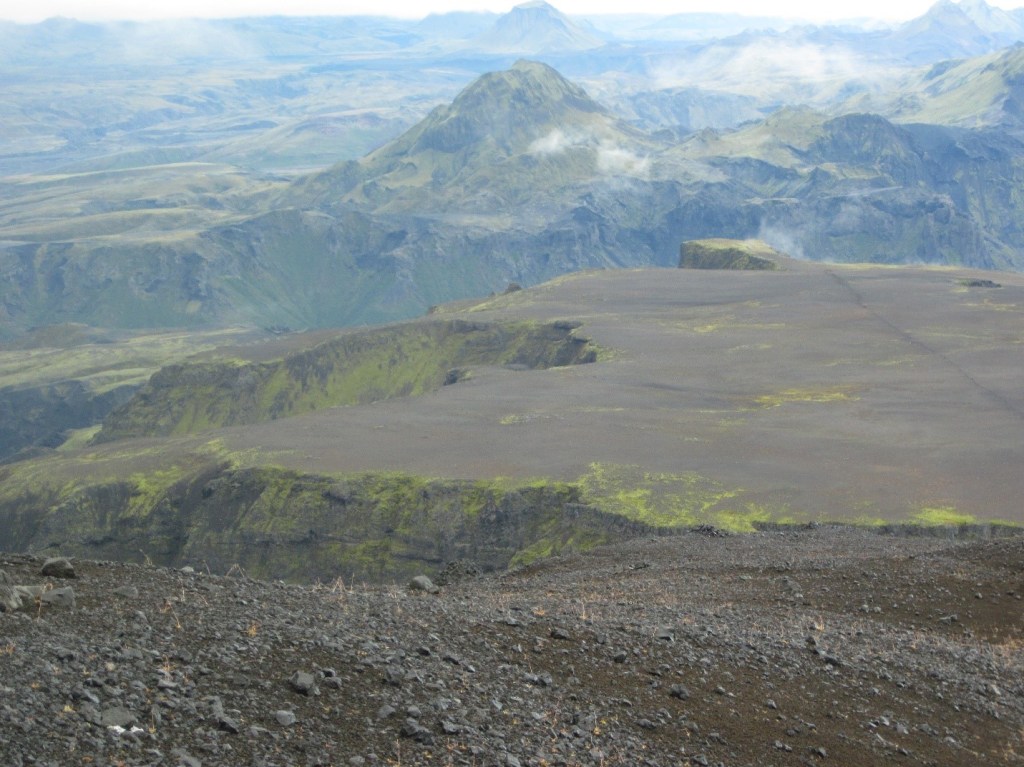
The trail crossed a wide, shallow bowl of bare ground in the foreground of the glacier, emptied by the warming climate. Further, the landscape turned blacker where even moss couldn’t gain a noticeable foothold in the outflow of the recent eruption of Eyjafjallajökull. I stopped and took the glove off my hand to take a couple of photos of the pumice formations. Sleet started to fall. I zipped up my rain jacket and continued across the crunchy terrain. When I crested the edge of the solidified lava flow, the Icelandic interior opened up into a scene from a Tolkien world. Sheer wisps of cloud loosely enshrouded a landscape of peaks and eroded valleys. Florescent green moss shaded certain contours of the slopes that had just the right microclimate to enable its growth. I could see the trail crossing a flat plateau below before disappearing off its furthest edge. I took out my camera and snapped a photo. And then another. And then a panoramic series across the 180-degree view. I made myself put the camera away to live in the moment. I cheated once to take a photo when some new valleys had opened up to my view.
Back in my living room at home, in the chaos that life is after returning from a trip, I looked disappointedly at those photos. So much is missing. The vibrance of the green is dulled, but there is more missing than that. It missed the context of the hike, the mileposts of geological time that I had passed to get there. It did not capture that glorious sense of unrestraint felt on the first day of a trip, nor the anticipation of what lay just off the edge of that plateau. If I had had a better camera and a better eye for photography, maybe I could have captured the scene that I saw with my eyes. I could have hung it on my wall to remind myself of what my eyes had seen in that moment. But it would have still been merely a flattened representation of all the dimensions that comprised the experience.
The itinerary we had outlined for our trip to Madagascar involved multiple taxi-brousse legs between Antannanarivo and Tulear along the most respectable of the potholed highways in the country. I credit the success of the first leg entirely to two men. The first, our private taxi driver, expertly navigated the narrow, spider-web layout of streets in the capital city to a soundtrack of Celine Dion. At the taxi-brousse station, he handed us off to another man who led us through the chaos of unmarked minibuses and made sure we stuffed ourselves into the correct one. After four hours intimately wedged between my husband and a man sitting on a footstool in the aisle, I was happy to get out when we arrived in Antsirabe.
While walking to the town center, we uncommittedly chatted with the several enterprising young guides who cordially and persistently courted us. That evening we reviewed our itinerary again. It was hypothetically doable, but we knew it didn’t leave much room for the unpredictability that seemed to characterize travel in Madagascar. In the morning we went to Chez Billy hostel to find out more details about the tour scheduled to leave the following day. The 6-day Tsiribihina river tour included the Parc National des Tsingy de Bemaraha, a remote labyrinth of karst spires and fins, not part of our original, self-guided itinerary because of its inaccessibility. The cost was reasonable, but quite a bit higher than what we would spend traveling independently around the country. The visit to the park, a Unesco World Heritage site, appealed to me as did having transportation and guides arranged for us for part of our trip. We reviewed the contract, signed, and agreed to pay half the cost that day and half upon departure.
The guide association only accepted cash, so we walked to the BNI Madagascar bank in the center of town. A security guard waved us into the room with two ATMs and shut the door, allowing us to extract our money alone and out of the view of all the people loitering outside. We started taking out money in increments of the US equivalent of about $100, received in twenty 20,000 Ariary bills, the largest bill. The ATM would only give a specific number of bills in any one transaction; we repeated this transaction several times before depleting the machine of Ar20,000 bills. After spending enough time to draw an uncomfortable amount of attention to ourselves, we folded and tucked away the thick stack of bills amounting to the portion due that day. My once discreet travel wallet bulged under my clothing at my waistline as we walked back to Chez Billy.
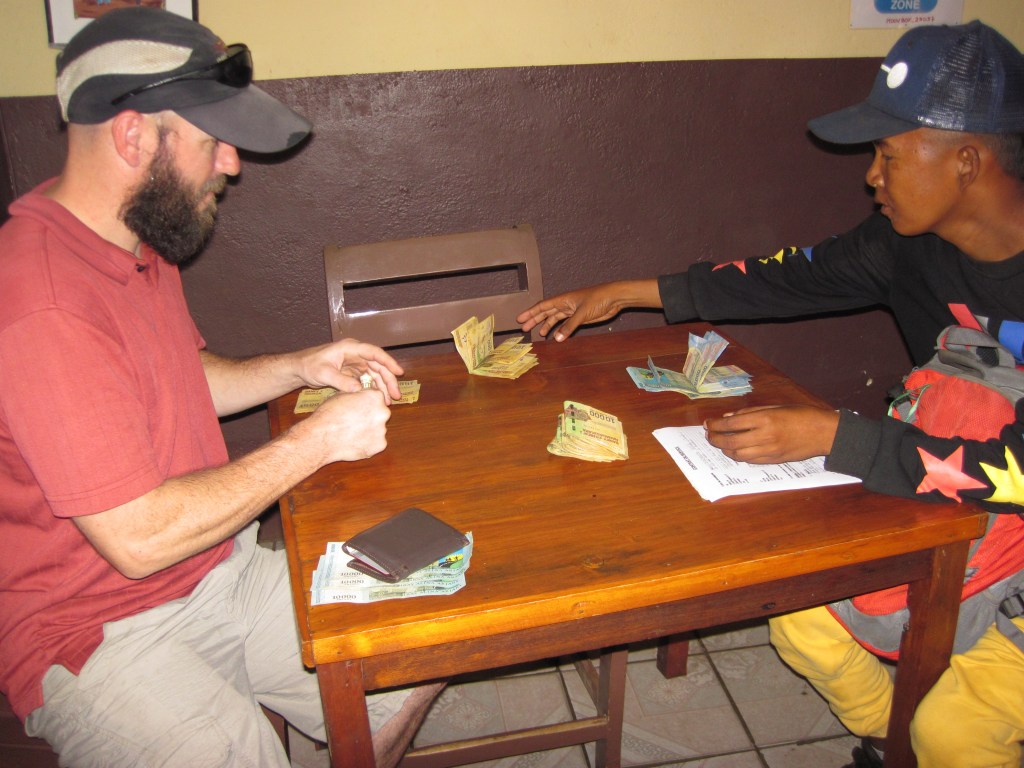
Back in a corner of the dimly lit hostel lobby, we carefully counted out 1.4 million Ariary and slid it across the table to the guide. He carefully recounted the colorful mélange of bills, arranging them in Ar100,000 stacks on the table. I glanced around the lobby to see who was witnessing the shady-feeling operation, relieved that the bills would no longer be in my possession. “I feel good about that,” my husband commented as we walked away. I agreed; it felt like a good way to spend our money. As I mentioned in my previous post, the poverty rate is high in Madagascar and tourism is lagging despite all the country has to offer. Hiring guides can contribute to the local economy and incentivize responsible use of the country’s cultural and ecological resources.
Later in the afternoon I took a walk around the village, visiting several artisan shops and buying a few small souvenir items. I took the long way back to our lodge so I could observe how everyday life happens in ways unfamiliar to me. The road I walked dipped down to a stream flanked by rice paddies. Just upslope, several people picked through a small trash dump, a scene I observed on several occasions in Madagascar. Trying not to stare as I passed, I glanced over and noticed that one of the people sitting in the rubbish was a young girl holding an infant. I looked away and walked on by.
We had dinner reservations that evening at Chez Jenny, the upscale restaurant attached to our lodge. We were seated at a table overlooking a pond and botanical garden. The waiter promptly came over to give us menus and light the candle on our table. We unfolded our napkins from their fancy configurations. Our meals came artfully arranged on their plates. In the U.S. the whole experience would have cost much more than I would choose to pay for a dinner out. We decided to split one dessert, because we were fairly full from our meals. We pointed at one of the French names and descriptions on the menu that had the word for chocolate in it. It arrived on a small plate – a mound of whipped cream – with two spoons. We excavated the sweetness to uncover two cream puff shells filled with ice cream, one vanilla and the other chocolate, both exceptionally creamy and rich in flavor. I’m not sure I’ve ever eaten anything so decadent.
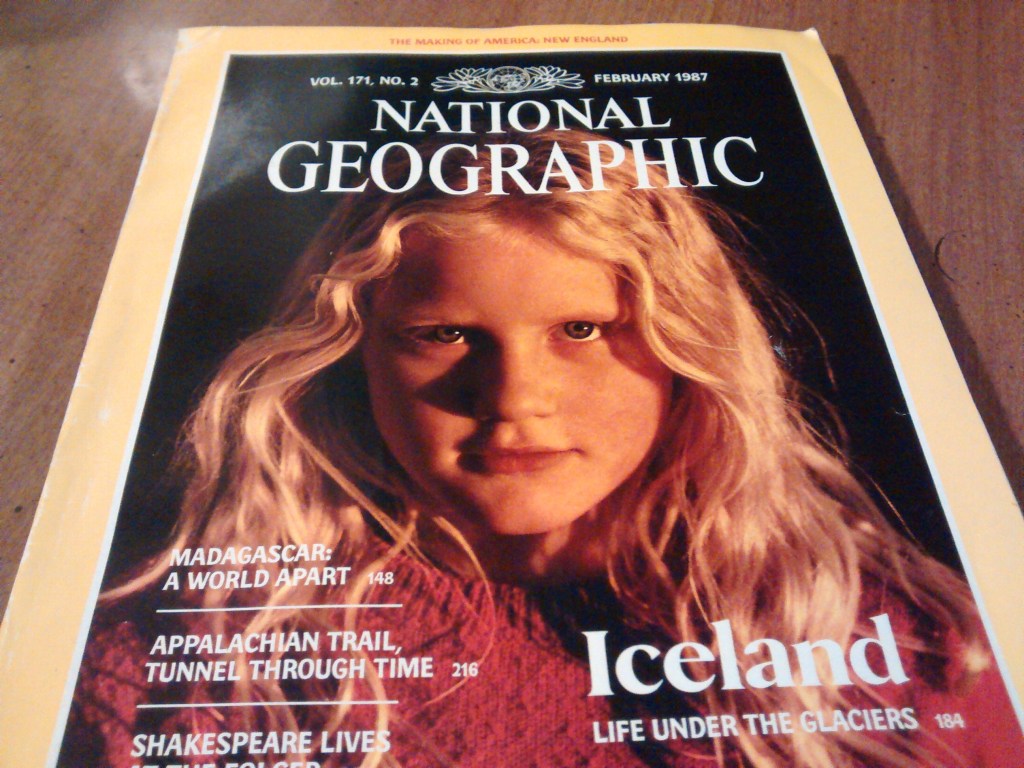
I just had to order the February 1987 issue of National Geographic, because it featured the two countries on my travelogue for this year, Iceland and Madagascar. When my copy came in the mail, I quickly turned to the page with the editor’s note. I skimmed his write-up and was disappointed that he had made no mention of how profoundly different these two island nations mentioned on the cover of his magazine are from each other.
They do share some similarities in their human history. Both were among the last land masses to be inhabited by humans, around the middle of the first millennium. Both gained their independence only recently, in the first half of the 20th century. Both countries boast a literary culture embellished by proverbs and poetry with complicated rules. Neither the Malagasy or Icelandic languages conserve syllables in their verbiage.
They have little else in common. Madagascar is just over twice as large in area and has 22,586,000 people to Iceland’s 353,574. Most people can find Iceland on a map. A mere 255,000 people visited Madagascar in 2017. That same year, Iceland welcomed 2,225,000 tourists. Yes, that’s over 2.2 million, over six times the country’s population. I could not argue the merits of visiting Iceland; it is a spectacular country. But, I want to advocate Madagascar as a grossly underappreciated travel destination.
Madagascar, often referred to as “the eighth continent,” contains a diversity of landscapes, from rainforest to desserts to mountains to beaches to strange limestone formations. When it comes to wildlife, the two countries are truly worlds apart. Madagascar is a premier wildlife tourism destination. When counting total numbers of Malagasy species, one has to condition any count as that of “described species,” because new species are regularly being discovered. The most charismatic of its wildlife – the 100+ species of lemurs – are naturally found nowhere else in the world. Iceland has only one native species of land mammal, the circumpolar arctic fox. While trekking with your guide searching for ubiquitous lemurs, you will also encounter some of the nearly 400 species of reptiles and over 300 species of frogs found on the island. Over 90% of these are endemic. Iceland does not support a single native reptile or amphibian species. Iceland does regularly host a respectable 72 species of regularly breeding birds. Madagascar only has about 260 regularly occurring bird species, low relative to other groups of animals. The attraction for birders is that about 100 of these bird species cannot be seen anywhere else in the world. Iceland has no endemic species of any taxa, including those among its 483 native or naturalized plant species. Madagascar has over 10,000 native plant species, including 260 endemic genera of plants, representing a multitude of endemic species.
Despite its substantial contribution to global biodiversity, Madagascar remains a poor country. Icelanders enjoy a GDP per capital of $38,000 to the Malagasy’s $900. Tourism expenditures brought $1.66 billion dollars to Iceland in 2017 and only $319 million to Madagascar. Could more visitors change the economic situation for the Malagasy? And could they change this in a way that respects and conserves what Madagascar has to offer?
Country statistics came from Knoema. Iceland biodiversity statistics were obtained from the Biodiversity on Iceland: National Report to the Convention on Biological Diversity. Madagasca’s biodiversity statistics came from Peter Tyson’s The Eighth Continent: Life Death, and Discovery in the Lost World of Madagascar and Ken Behrens and Keith Barnes’ Wildlife of Madagascar.
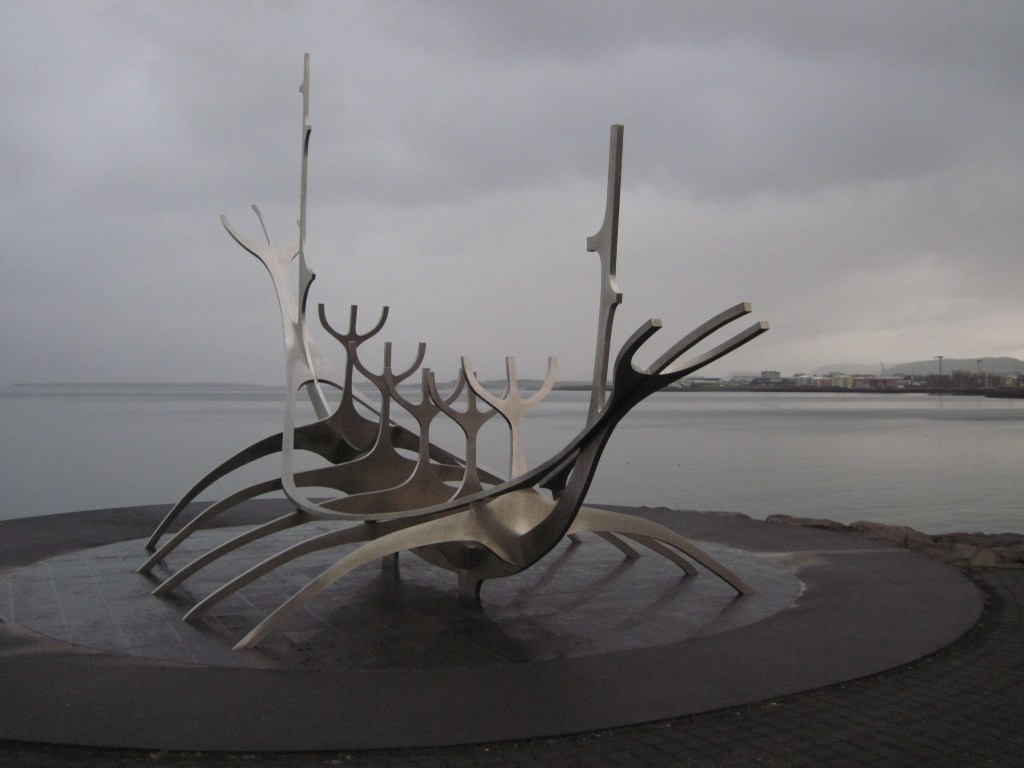
I’m usually not particularly moved by sculpture. Sure, I can appreciate some pieces, especially those that resemble familiar objects, like the stylized, yet obvious rendering of a ship at the harbor in Reykjavik. “Walk around it,” one of my friends suggested while I gazed up at the structure. I slowly walked clockwise, gazing from all angles at the sharp silver lines reflecting the sun. It was nice, but I didn’t feel any different after I finished.
Two days later, four of us women drove out of the city in a rental camper van. After some stressful laps around traffic circles, we began our trip circling Iceland on the popular Ring Road. After six full days of waterfalls, geysers, glaciers, puffins, rain, hot baths, craters, a flat tire, beaches, and more rain, we returned to where we had started. And, I am changed.
Circumambulation around a sacred object or site is a spiritual practice found in many religions. The first image to come to mind may be the blur of pilgrims circumambulating the ka’aba in Mecca. In the Christian tradition, the space in Romanesque and Gothic churches where one can walk around the central nave is called the “ambulatory.”
When we travel, we move around and through different places in our world. I am starting this blog to explore how we are changed through the practice of circumambulating the globe and the moments we find sacred along the way. I will also post my travel itineraries, as I find others’ to be useful resources when I am planning a trip.
 Circumambulating the Globe