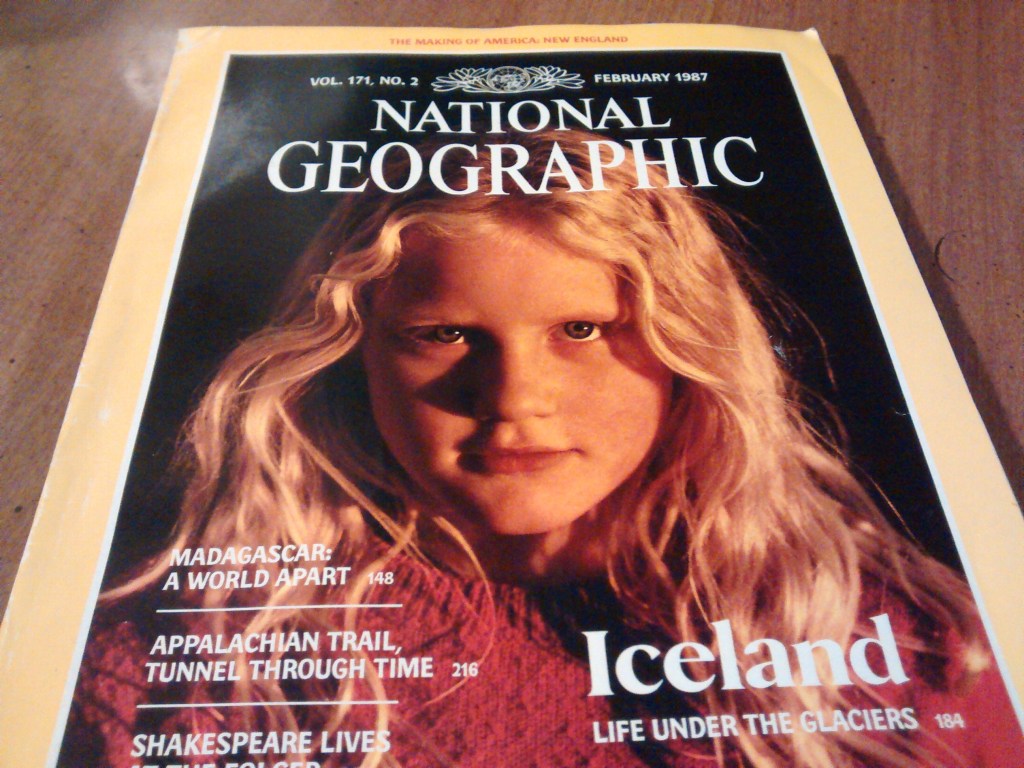
I just had to order the February 1987 issue of National Geographic, because it featured the two countries on my travelogue for this year, Iceland and Madagascar. When my copy came in the mail, I quickly turned to the page with the editor’s note. I skimmed his write-up and was disappointed that he had made no mention of how profoundly different these two island nations mentioned on the cover of his magazine are from each other.
They do share some similarities in their human history. Both were among the last land masses to be inhabited by humans, around the middle of the first millennium. Both gained their independence only recently, in the first half of the 20th century. Both countries boast a literary culture embellished by proverbs and poetry with complicated rules. Neither the Malagasy or Icelandic languages conserve syllables in their verbiage.
They have little else in common. Madagascar is just over twice as large in area and has 22,586,000 people to Iceland’s 353,574. Most people can find Iceland on a map. A mere 255,000 people visited Madagascar in 2017. That same year, Iceland welcomed 2,225,000 tourists. Yes, that’s over 2.2 million, over six times the country’s population. I could not argue the merits of visiting Iceland; it is a spectacular country. But, I want to advocate Madagascar as a grossly underappreciated travel destination.
Madagascar, often referred to as “the eighth continent,” contains a diversity of landscapes, from rainforest to desserts to mountains to beaches to strange limestone formations. When it comes to wildlife, the two countries are truly worlds apart. Madagascar is a premier wildlife tourism destination. When counting total numbers of Malagasy species, one has to condition any count as that of “described species,” because new species are regularly being discovered. The most charismatic of its wildlife – the 100+ species of lemurs – are naturally found nowhere else in the world. Iceland has only one native species of land mammal, the circumpolar arctic fox. While trekking with your guide searching for ubiquitous lemurs, you will also encounter some of the nearly 400 species of reptiles and over 300 species of frogs found on the island. Over 90% of these are endemic. Iceland does not support a single native reptile or amphibian species. Iceland does regularly host a respectable 72 species of regularly breeding birds. Madagascar only has about 260 regularly occurring bird species, low relative to other groups of animals. The attraction for birders is that about 100 of these bird species cannot be seen anywhere else in the world. Iceland has no endemic species of any taxa, including those among its 483 native or naturalized plant species. Madagascar has over 10,000 native plant species, including 260 endemic genera of plants, representing a multitude of endemic species.
Despite its substantial contribution to global biodiversity, Madagascar remains a poor country. Icelanders enjoy a GDP per capital of $38,000 to the Malagasy’s $900. Tourism expenditures brought $1.66 billion dollars to Iceland in 2017 and only $319 million to Madagascar. Could more visitors change the economic situation for the Malagasy? And could they change this in a way that respects and conserves what Madagascar has to offer?
Country statistics came from Knoema. Iceland biodiversity statistics were obtained from the Biodiversity on Iceland: National Report to the Convention on Biological Diversity. Madagasca’s biodiversity statistics came from Peter Tyson’s The Eighth Continent: Life Death, and Discovery in the Lost World of Madagascar and Ken Behrens and Keith Barnes’ Wildlife of Madagascar.
 Circumambulating the Globe