The earliest bus leaving Reykjavík brought me to the trailhead in Skogar at noon. To make it all the way to Landmannalaugar in four days, I couldn’t afford to wait until the following day to start north on the Fimmvörðuháls Trek. Sleeping accommodations between there and Pórsmörk were limited and had to be reserved far in advance, so I was committed to the entire 23.4 km that afternoon. Before I started, I asked another tourist to take a photo of me in front of Skogasfoss, an enormous waterfall. That day’s hike felt like an entire journey in itself, and not just because of the length. It seemed unfathomable to have traversed such a breadth of landscapes over that distance. After the short, steep ascent to the top of Skogarfoss, the trail followed the Skogar River upstream where it tumbled down a series of smaller, still photo-worthy, drops. Across the grassy highlands, two glaciers in the distance covered the tops of mountains. I stopped several times to take photos as I hiked nearer. Finally, the trail crossed a tongue of one of the glaciers. I carefully placed my feet on the slippery surface. I snapped several photos of where the ice formed peaks like meringue, darkened with ash.
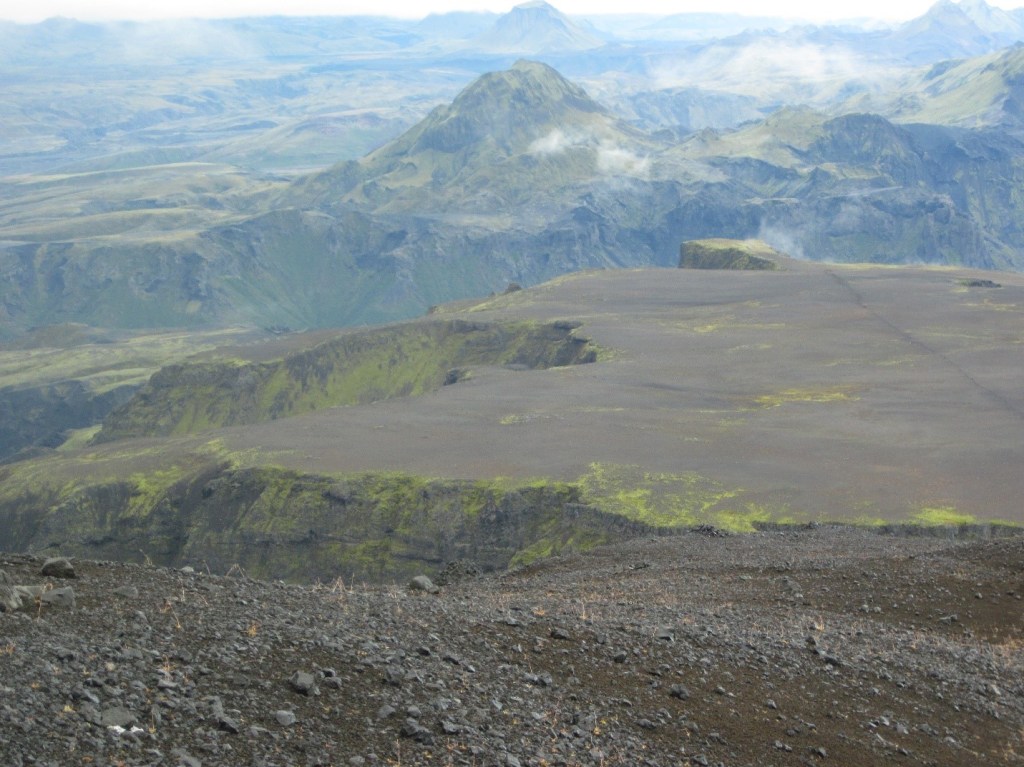
The trail crossed a wide, shallow bowl of bare ground in the foreground of the glacier, emptied by the warming climate. Further, the landscape turned blacker where even moss couldn’t gain a noticeable foothold in the outflow of the recent eruption of Eyjafjallajökull. I stopped and took the glove off my hand to take a couple of photos of the pumice formations. Sleet started to fall. I zipped up my rain jacket and continued across the crunchy terrain. When I crested the edge of the solidified lava flow, the Icelandic interior opened up into a scene from a Tolkien world. Sheer wisps of cloud loosely enshrouded a landscape of peaks and eroded valleys. Florescent green moss shaded certain contours of the slopes that had just the right microclimate to enable its growth. I could see the trail crossing a flat plateau below before disappearing off its furthest edge. I took out my camera and snapped a photo. And then another. And then a panoramic series across the 180-degree view. I made myself put the camera away to live in the moment. I cheated once to take a photo when some new valleys had opened up to my view.
Back in my living room at home, in the chaos that life is after returning from a trip, I looked disappointedly at those photos. So much is missing. The vibrance of the green is dulled, but there is more missing than that. It missed the context of the hike, the mileposts of geological time that I had passed to get there. It did not capture that glorious sense of unrestraint felt on the first day of a trip, nor the anticipation of what lay just off the edge of that plateau. If I had had a better camera and a better eye for photography, maybe I could have captured the scene that I saw with my eyes. I could have hung it on my wall to remind myself of what my eyes had seen in that moment. But it would have still been merely a flattened representation of all the dimensions that comprised the experience.
 Circumambulating the Globe